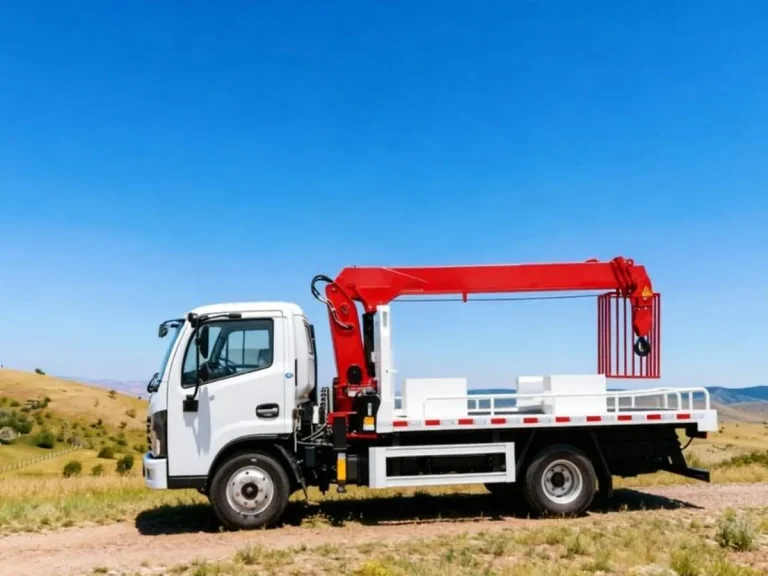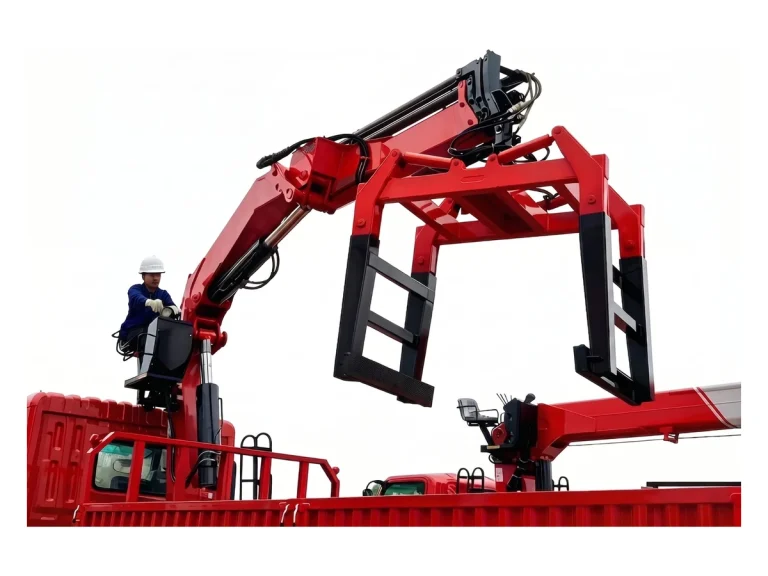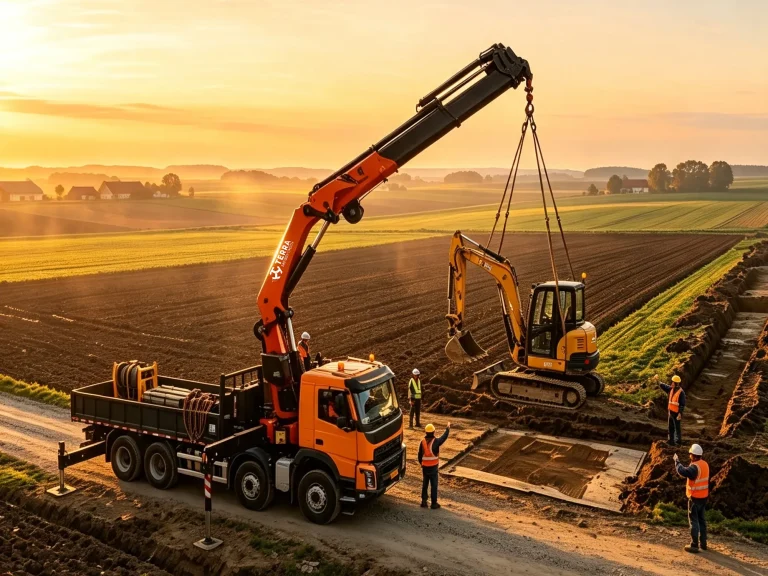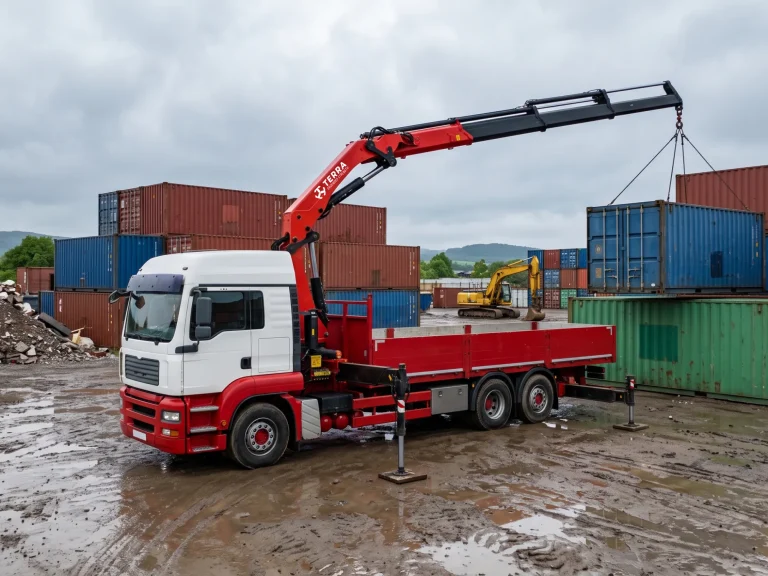

Lorry crane subframe mounting is the critical engineering phase where a bare superstructure is integrated onto a commercial truck chassis, determining vehicle torsional rigidity and anti-toppling stability. Installing high-tonnage 15–30 ton cranes on standard commercial platforms—such as HOWO, ISUZU, or Shacman—requires specialized subframe reinforcement to distribute dynamic bending moments across axle mounts. Utilizing high-tensile EN 10149-2 S700MC steel for both boom and subframe fabrication reduces superstructure tare weight by 15%, preserving legal cargo payload. Modern integration standards mandate installing automated Stability Control Systems (SCS) with real-time pressure sensors on outriggers to eliminate tipping risks under continuous load. Combined with stacked dual hydraulic pumps to isolate circuit pressure, engineered subframe mounting ensures long-term chassis durability and regulatory compliance globally. Terra Crane specializes in manufacturing high-performance crane superstructures and attachments designed for seamless integration with commercial truck chassis by local body builders. Importing containerized 40HQ bare attachments optimizes shipping logistics while delivering maximum transport ROI.
By utilizing containerized 40HQ packing for bare superstructures, fleet operators bypass costly complete vehicle shipping while deploying robust, anti-corrosive structural systems engineered to perform flawlessly under continuous load.
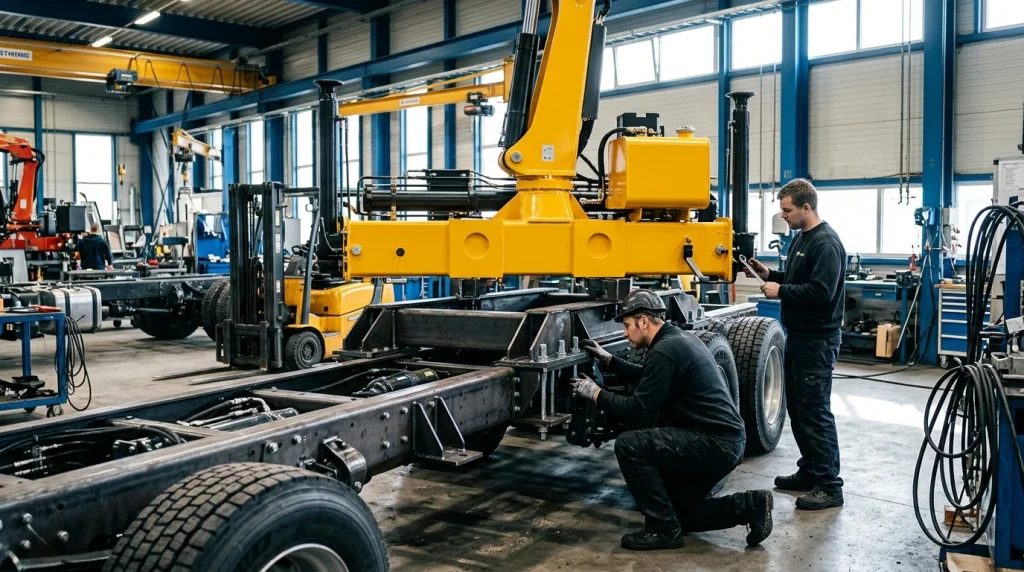
Why Subframe Engineering Dictates Chassis Longevity and Tipping Safety
When mounting a high-capacity loader crane superstructure onto a commercial truck, the original vehicle frame cannot absorb the immense concentrated bending moments and torsional forces generated during heavy lifting. Without a dedicated intermediate subframe (auxiliary frame), the localized stress will crack truck chassis rails, deform suspension mounts, and cause dangerous vehicle instability.
For global truck body builders and fleet assemblers, correct subframe engineering performs three vital functions:
- Stress Distribution: It transfers concentrated lifting loads evenly across the vehicle’s chassis rails and axle groupings.
- Torsional Rigidity: It resists twisting forces during side-slewing operations when the boom extends to maximum radius.
- Legal Payload Optimization: Utilizing lightweight, high-tensile materials minimizes deadweight, allowing standard 3-axle and 4-axle trucks to carry maximum legal cargo.
3 Core Engineering Rules for Lorry Crane Subframe Installation
1. Torsional Box Design & S700MC High-Strength Steel Selection
A standard channel-section beam is insufficient for modern mid-to-heavy capacity cranes (15–30 MT). Body builders must fabricate closed-box or cross-braced subframe structures. Fabricating the subframe from EN 10149-2 S700MC high-strength steel (yield strength ~700 MPa) allows for thinner steel profiles while doubling the resistance to fatigue cracking. This reduces auxiliary frame weight by up to 15%, directly increasing usable payload on the truck bed. That range maps onto two of our superstructures in particular: the 16-ton knuckle boom crane TK3205 and the 16-ton stiff boom crane TS4005, both shipped as bare units so the body builder fabricates the subframe locally.
2. Flexible vs. Rigid Chassis Connection
Rigidly welding a subframe along the entire truck chassis rail destroys the vehicle’s natural frame flexibility, leading to stress fractures during off-road transit. Engineering best practices enforce a hybrid fastening system:
- Front Shear Plates: Flexible or semi-flexible bracket connections near the front cab allow natural chassis flex during driving.
- Rear Rigid Plates & High-Tensile U-Bolts: High-strength shear plates and fine-thread U-bolts near the crane pedestal mount create a rock-solid foundation to absorb dynamic lifting moments.
3. Automated Stability Control Systems (SCS) & Outrigger Interlocks
Global regulatory standards—including Singapore MOM stability mandates, UK ALLMI codes, and European EN 12999 standards—increasingly require automated stability protection on new lorry cranes. Modern subframes integrate electronic Stability Control Systems (SCS) connected to outrigger pressure sensors and extension length encoders. If an outrigger loses ground contact pressure or is insufficiently extended, the SCS automatically restricts crane movement toward the unstable zone, eliminating toppling risks.
| Crane Tonnage Class | Recommended Subframe Profile | Material Grade | Chassis Compatibility | Stability System Mandate |
|---|---|---|---|---|
| 5 – 8 Ton (Light Duty) | Open C-Channel / L-Plate | S355 / S700MC Hybrid | ISUZU, Hino, Foton (2-Axle) | Mechanical Outrigger Interlocks |
| 10 – 16 Ton (Medium Duty) | Closed Box Section | EN 10149-2 S700MC | HOWO, Dongfeng, FAW (3-Axle) | Automated SCS + Outrigger Sensors |
| 20 – 30 Ton (Heavy Duty) | Double Box / Cross-Braced | Premium S700MC Steel | Shacman, HOWO, FAW (4-Axle) | Full Electronic SCS + Dual Pump Control |
> “Subframe integration is where theoretical crane capacity meets real-world safety. By combining S700MC high-tensile steel subframes with automated stability interlocks, we enable global body builders to deliver road-legal, ultra-safe crane trucks with maximum payload margins.” — Chief Structural Engineer, Terra Crane
Why is a dedicated subframe required when mounting a crane on a truck chassis?
How does S700MC high-strength steel improve crane subframe design?
What is a Stability Control System (SCS) for lorry cranes?
Models in this range
A subframe is only as good as the crane sitting on it. If you are quoting a 15-30 MT build, these are the three superstructures that class is usually fought over.
- 16-ton knuckle boom crane TK3205 — 16 t, folding boom
- 16-ton stiff boom crane TS4005 — 16 t, 5 sections
- 20-ton stiff boom crane TS500-5 — 20 t, 5 sections
Send your lifting spec Ask on WhatsApp
Load weight, working radius, chassis model — with those three we can send a load chart the same week.
Still comparing? Read the full selection guide first.