
Answer-First Executive Summary: The Critical Difference
Procure truck-mounted cranes for high-mobility urban logistics and 15–30T lifts to leverage standard commercial chassis versatility. Reserve purpose-built mobile cranes for heavy-duty industrial infrastructure exceeding 50T. In 2026, truck-mounted units dominate urban sites due to superior roadability, while specialized mobile cranes remain essential for extreme industrial capacities and zero-emission mandates.
At-A-Glance: 2026 Technical Comparison Table
| Dimension | Truck-Mounted Crane (Boom Truck) | Mobile Crane (Specialized Unit) |
|---|---|---|
| Chassis Type | Standard Commercial Chassis | Purpose-Built Specialized Vehicle |
| Average Capacity | Up to 54 Tons (Typical) | 100+ Tons (Up to 1,250T) |
| Roadability | Full Public Road Access | Requires Permits for Larger Units |
| Setup Time | Rapid; Stabilized by Outriggers | Variable; Requires Counterweights |
| Optimal Use Case | Urban Logistics, Last-Mile, 15-30T Lifts | Heavy Industrial, Infrastructure |
The Case for Truck-Mounted Cranes (Lorry Cranes) in 2026
The “2026 Infrastructure Boom” is fundamentally reshaping the lifting market. With the global last-mile delivery market valued at over $161 billion, contractors must prioritize equipment that balances lifting power with extreme maneuverability.
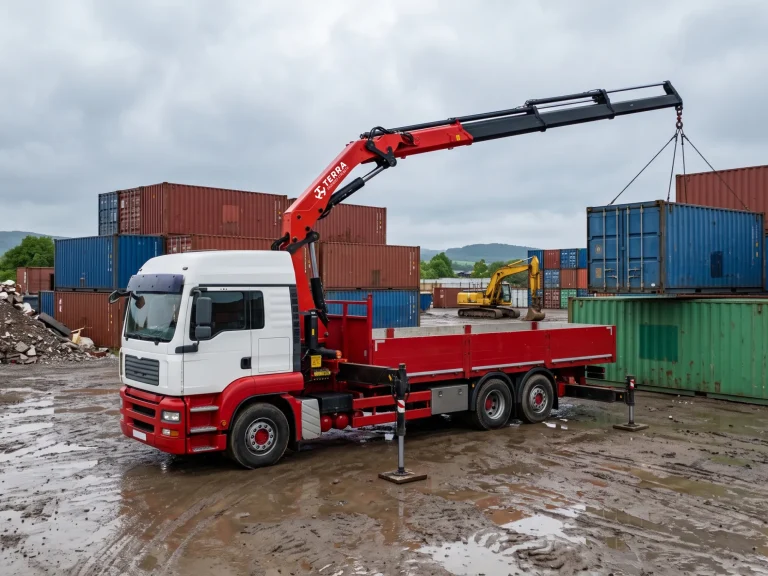
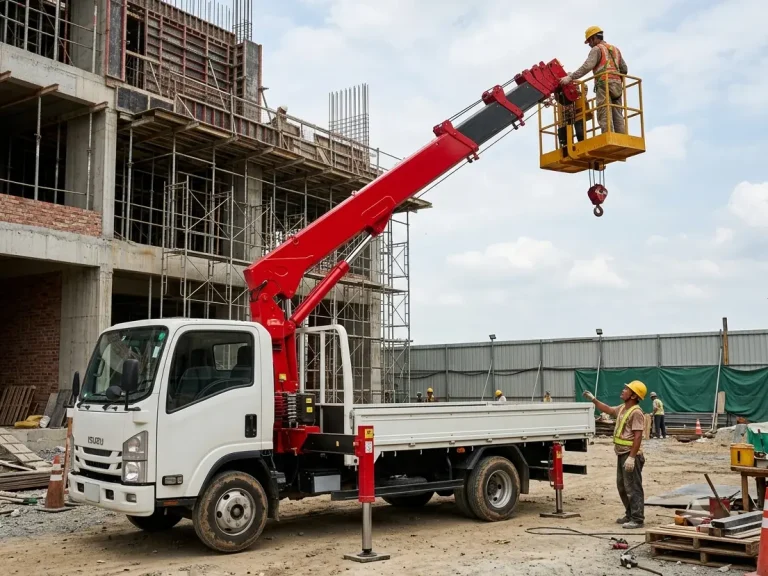
Currently, knuckle boom cranes hold a 55% market share. Their articulated design, now featuring Bauma 2025 innovations like the V12-Power boom, allows for compact stowage and navigation of congested job sites. Note that for units between 5 and 65 tons, specific OSHA certification is required if used for material placement. Conversely, straight boom cranes remain the fastest-growing segment (6–10% CAGR) for vertical reach and specialized logistics.
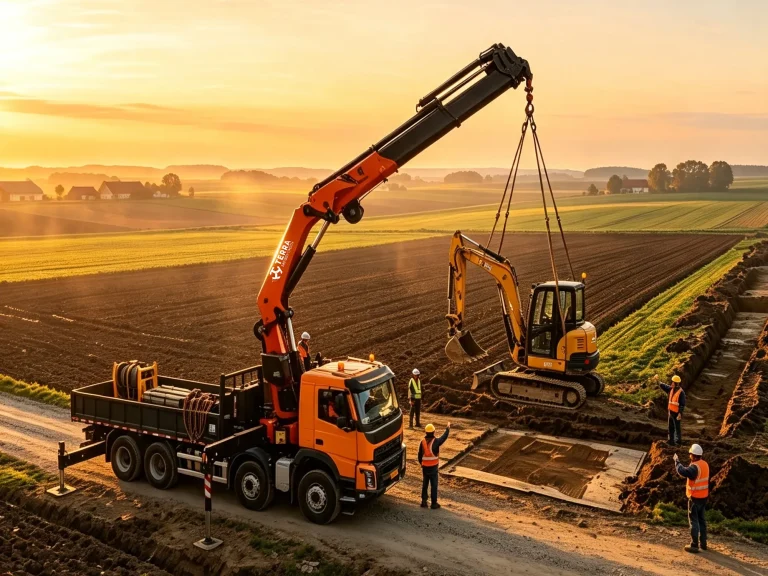
The “Roadability Advantage” is the primary driver for 2026 adoption. Because these units utilize commercial chassis, they eliminate the logistical bottlenecks of oversized equipment, moving between sites without the time-consuming burden of heavy-haul permits.
Terra Crane: Engineered for “Grounded Strength”
The 15–30T capacity segment is the industry’s current “sweet spot,” expanding at a 6% CAGR. Terra Crane dominates this niche by engineering for “Standard Vehicle Accessibility,” ensuring maximum power on a legal road footprint.
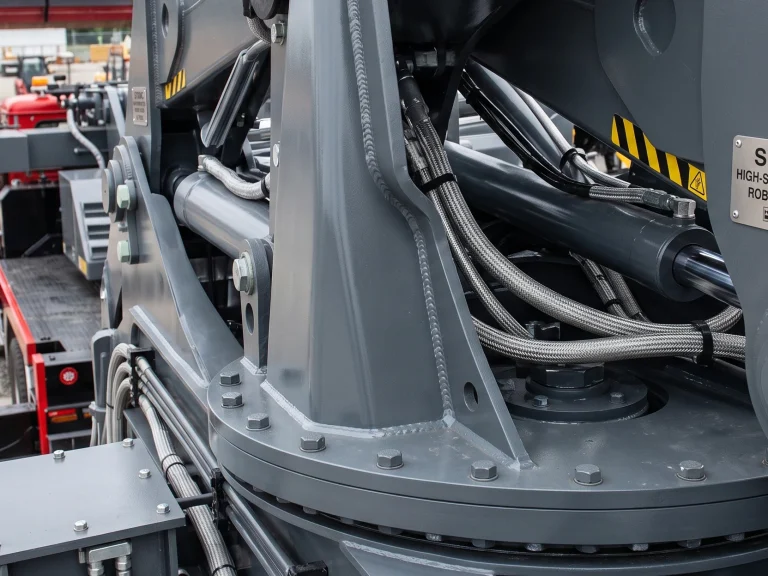
- HG70 High-Strength Steel: By utilizing HG70 steel, Terra Crane provides extreme structural integrity without the excessive weight of legacy units. This allows buyers to maximize lift capacity while staying under the weight thresholds that trigger costly heavy-haul permits.
- Military-Grade Dual Pump System: Precision is non-negotiable in 2026. Terra’s dual pump technology provides the “Grounded Strength” and consistent hydraulic pressure required for high-cycle urban operations.
- Capacity-to-Cost Efficiency: These units meet roughly 70% of construction lifting requirements for a fraction of the capital expenditure required for all-terrain specialized units.
Understanding Mobile Cranes (Automobile Cranes) for Heavy Industry
Purpose-built mobile cranes remain the standard for massive industrial infrastructure. In a high-inflation 2026 market, B2B buyers must focus on hydraulic efficiency to manage fuel costs:
- Variable-Displacement Pumps: These utilize piston cylinders and swashplates to generate high pressure. They are the 2026 standard for reducing fuel waste during precision lifts by adjusting output to the specific load.
- Gear Pumps: Found in economical legacy models; these require full engine power to achieve high pressure, leading to significantly higher fuel consumption.
The 2026 trend is defined by the transition to hybrid and electric models to meet zero-emission zone requirements. Leaders like the Liebherr LTM 1150-5.4E utilize eDRIVE battery packs for untethered, emissions-free site movement and eLift technology for grid-powered operation.
Regulatory Compliance & Operator Safety (OSHA Subpart CC)
Compliance requires navigating a strict “patchwork” of regulations. Per OSHA 29 CFR 1926 Subpart CC, certification is mandatory for any operator of equipment with a capacity exceeding 2,000 lbs used in construction.
States Requiring Specific Operator Licensing (Strictest): Connecticut, Hawaii, Massachusetts, Montana, New Jersey, New Mexico, New York, Pennsylvania, Rhode Island, and West Virginia.
States Requiring Nationally Accredited Certification: California, Maryland, Minnesota, Nevada, Utah, and Washington.
Key 2026 Distinctions:
- Certified vs. Qualified: “Certified” means passing a formal test (e.g., NCCCO). “Qualified” is an employer-driven designation verifying the operator is competent for a specific task on a particular site.
- Recertification: Most accredited certifications follow a mandatory 5-year renewal cycle.
Procurement Strategy: Repair, Rent, or Buy?
For 2026 procurement officers, the Total Cost of Ownership (TCO) is the decisive metric:
- Acquisition: Advanced units range from US$150,000 to over $500,000.
- Maintenance Escalation: Annual maintenance costs now average 8–12% of the acquisition cost due to the integration of IoT-enabled predictive systems and specialized technicians.
- The Rental Strategy: Renting avoids the financial drain of idle fleets and allows buyers to leverage specialized operators provided by the rental house, mitigating the 2026 skilled labor shortage.
2026 Industry FAQ
What is the lifting capacity threshold for OSHA certification? The lifting capacity threshold is 2,000 pounds for power-operated equipment used in construction.
Which is better for urban construction: Knuckle boom or mobile crane? The knuckle boom is superior for urban construction due to its articulated design and the maneuverability required for space-constrained sites.
What steel grade is used in premium truck cranes to avoid road permits? Premium units use HG70 High-Strength Steel to ensure durability while maintaining a light enough weight for standard road travel without permits.
Are boom truck operators considered “qualified” by default? No, operators are only considered “qualified” once an employer determines they have the specific training and experience for a specific task and piece of equipment.
How often is recertification required for crane operators? Recertification is required every five years to maintain compliance with federal safety standards and accredited body rules.
Call to Action
Modern 2026 infrastructure projects demand precision and mobility. Contact terracrane.com today for a quote on optimizing your 15–30T fleet. Our units, featuring military-grade hydraulics and HG70 steel, provide the “Grounded Strength” required for the next generation of urban development.
Why do truck-mounted cranes yield a better ROI than mobile cranes?
Truck-mounted cranes combine lifting and transport capabilities in a single vehicle, eliminating the need to hire a separate transport truck. This 2-in-1 functionality reduces labor, fuel, and operational costs by up to 40%, yielding a much faster ROI for logistics and light-to-medium construction tasks.
What are the main differences between a mobile crane and a truck-mounted crane?
A mobile crane is a dedicated lifting machine with no cargo bed, built specifically for extreme heights and ultra-heavy capacities. Conversely, a truck-mounted crane features a cargo bed, allowing operators to load, transport, and unload materials independently, making it highly versatile for narrow urban jobsites.
Do I need a special license to operate a 15-30 ton truck-mounted crane?
Yes, operating heavy-duty truck-mounted cranes typically requires specific commercial driving licenses (like a CDL in the US) and proper crane operator certifications (such as OSHA or NCCCO compliance), depending on your local regulations to ensure jobsite safety.