“In 2026, buyers are no longer just asking ‘how much can it lift?’ They are asking ‘how smartly does it operate?’ At Terra Crane, we’ve seen a 40% shift in inquiries specifically targeting precision dual-pump hydraulics over raw tonnage.” > — Chief Engineer, Terra Crane
1. Executive Summary: The 2026 Crane Market at a Glance
The 2026 truck-mounted crane market marks a definitive pivot in industrial procurement. The industry has transitioned from “brute force” to “intelligent control and sustainability,” where operational data and emission compliance are now as critical as lifting capacity. Driven by massive public infrastructure investment—estimated at $850 billion to $950 billion over the next decade—the market is prioritizing high-precision, low-emission equipment that integrates seamlessly into AI-driven logistics networks.
Key 2026 Metrics:
-
- Global Market Valuation: $7.72 billion to $8.15 billion.
-
- Projected CAGR: 6.2%.
-
- Fastest-Growing Region: Asia-Pacific (projected to reach 40% market share by 2033 with a 7–12% regional CAGR).
-
- Strategic Focus: Shift from raw power to intelligent control systems, IoT-enabled predictive maintenance, and zero-emission operational capabilities.
2. Knuckle Boom vs. Telescopic: Performance Benchmarks for 2026
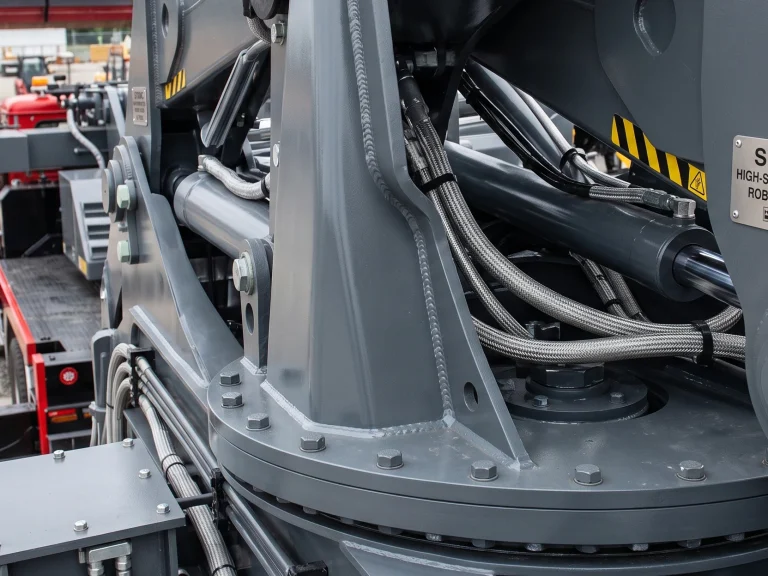
The technical selection between articulating (knuckle) booms and straight (telescopic) booms is now governed by specific jobsite geometry and attachment requirements. While European models like the Palfinger PK 880 TEC set benchmarks for live data, manufacturers like Terra Crane (a strategic partner of Sany Palfinger) are bridging the gap by equipping their models with military-grade dual pumps and European-standard proportional control valves, offering premium precision at a more accessible CapEx.
Performance Comparison: Articulating (Knuckle) vs. Telescopic Booms
| Feature | Knuckle Boom (Articulating) | Telescopic (Straight Boom) |
| Working Space Requirements | Optimized for narrow, congested areas; ideal for indoor warehouses and city streets. | Requires large, open operating space; less ideal for environments with overhead obstacles. |
| Vertical Reach | Superior for navigating around obstacles via “jointed” movement. | Exceptional for high-vertical placement and deep reach using linear extension. |
| Setup Time/Efficiency | Faster setup and shorter operating cycles; higher work efficiency in repetitive loading. | Slower setup due to wire rope/winch mechanisms; requires greater structural clearance. |
| Attachment Versatility | High; utilizes mechanical hands, grippers, and augers for robotic-like precision. | Limited; primarily utilizes standard wire rope and winch-hook mechanisms. |
| Stowage & Payload | Compact stowage; boom folds entirely to maximize truck bed space for cargo. | Occupies significant horizontal space; boom typically stows over the cab or the bed. |
3. The 15-30 Ton “Sweet Spot”: Why This Segment Dominates 2026
While the <10 MT (Metric Ton) segment remains vital for general urban agility, the 10–30 MT capacity range has emerged as the fastest-growing market segment, expanding at a 6% CAGR. This range represents the new “specialized efficiency” target for contractors requiring heavy-lift capability on standard vehicle platforms.
Primary Drivers for 15-30 Ton Growth:
-
- Infrastructure Investment in Urban Redevelopment: Global cities are investing 200–500 million annually in modernization. This requires mid-capacity cranes capable of handling heavy modular components in high-density environments.
-
- Rise of E-commerce and Logistics Fulfillment: The proliferation of micro-fulfillment centers requires cranes specialized in lifting heavy industrial racking and massive HVAC systems without the prohibitive footprint of a traditional mobile crane.
-
- Technical Advancements in Vehicle Chassis: Breakout hydraulics now allow for optimal weight distribution across axles. To meet this demand, Terra Crane’s 14T to 25T heavy-duty series, built with high-strength HG70 steel, has been specifically engineered to maximize payload without compromising standard truck chassis compliance.
4. The Cost-Benefit Analysis of Electric and Hybrid Cranes
The “Green ROI” has moved from a secondary benefit to a core procurement mandate. As demonstrated at Bauma 2025 by the Liebherr LTM 1150-5.4E and the Volvo A30 Electric, electrification is now a proven strategy for reducing Total Cost of Ownership (TCO).
-
- Operating Cost Reduction: Electric and hybrid drives achieve a 40-50% reduction in energy consumption compared to traditional diesel-only systems.
-
- Hydraulic Efficiency for Diesel Fleets: For contractors balancing the transition, maximizing hydraulic efficiency is paramount. Advanced systems utilizing dual-way balancing valves and high-efficiency cooling—standard on Terra Crane models—significantly reduce engine load and diesel consumption.
-
- Urban Access: The implementation of “zero-emission zones” in major cities like London and Paris has made electric or hybrid capability a prerequisite for public sector and city-center contracts.
5. Compliance & Certification: Navigating the 2025/2026 Regulatory PatchworkOperating without current certification represents an unacceptable legal and financial risk. OSHA mandate 29 CFR 1926 Subpart CC requires all operators of boom trucks with a lifting capacity over 2,000 lbs in construction to be fully certified.
Directive for Operators: Three Ways to Meet OSHA Mandates
-
- Nationally Accredited Certification: The most common and widely accepted path, typically involving NCCCO testing.
-
- Audited Employer Program: Internal qualification through an independently audited training program.
-
- State or Local Licensing: Certification through a government program that meets or exceeds federal OSHA standards.
6. Future Outlook: Procurement Secrets for 2026
-
- Strategic Sourcing: The industry has moved beyond rigid, calendar-based maintenance. By utilizing IoT sensors and digital twins, maintenance is now usage-based. Fleet managers can now use real-time data to predict part failure, reducing equipment downtime by 25-35%.
-
- Crane-as-a-Service (CaaS): To mitigate risk in volatile markets, many firms are adopting CaaS models. This allows companies to access high-spec technology through an Operating Expense (OpEx) model rather than a high-capital investment (CapEx) purchase.